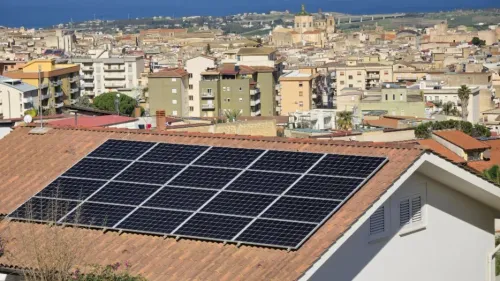
A panel that fits your roof can still produce disappointing results if shade, roof condition, household demand or inverter limits were overlooked. By checking the site, electricity use, panel specifications, system design and installer documentation, you can compare proposals on expected energy and long-term reliability rather than panel wattage alone.
Key takeaways
- Measure unshaded roof space after excluding vents, ridges, paths and setbacks.
- Use 12 months of electricity bills to size the system accurately.
- Compare panel efficiency, temperature coefficient, warranty terms and inverter compatibility.
- Require capacity, generation assumptions, protection equipment and service terms in writing.
Does Your Roof Suit a Solar Array?
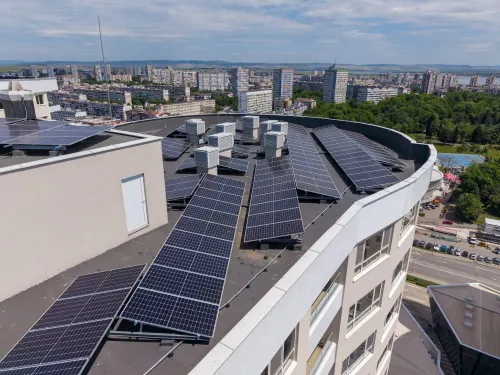
A roof suits solar only after you confirm enough unshaded, structurally sound space and a workable connection to your electrical system. Measure usable roof area after excluding ridges, vents, skylights, access paths and required setbacks. Compare panel dimensions, not wattage alone.
Check roof age, underlayment, leaks, load capacity, mounting method and safe access; replacing the roof later can require removing and reinstalling the array.
- Run a roof shading analysis across the day and year, including trees, parapets and nearby buildings.
- Record roof orientation and roof tilt, then model annual production instead of rejecting east- or west-facing sections automatically.
- Review at least 12 months of bills. Annual consumption, daytime demand and planned loads such as an electric vehicle, heat pump or electric water heater determine whether the available area is sufficient.
- Confirm permitting, electrical inspection, utility interconnection, export limits and meter requirements before selecting equipment.
| Orientation | Production pattern | What to check |
|---|---|---|
| South-facing | Balanced daily production | Compare shading and modeled annual output |
| East-facing | More morning production | Useful when morning demand is high |
| West-facing | More afternoon production | Useful when evening demand is high |
| Flat or low-tilt | Depends heavily on mounting angle | Check drainage, wind loading and row-to-row shading |
How Much Electricity Must the System Supply?
Use 12 months of electricity bills to calculate annual consumption, not just the highest monthly bill. Separate daytime and nighttime consumption, then add future loads such as an air conditioner, pump, electric vehicle, heat pump or electric water heater. Size the photovoltaic array from this demand, the utility’s rates and modeled production—not roof area alone.
NREL’s PVWatts calculator estimates production using location, system size, orientation, tilt, shading and losses.
| System type | Sizing basis | What to verify |
|---|---|---|
| Grid-connected | Annual consumption and expected annual generation | Utility export limits and billing structure |
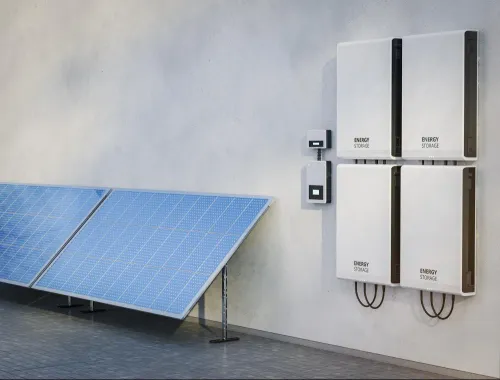
| Grid-connected with backup | Selected critical loads during an outage | Battery energy, inverter power and a critical-loads panel |
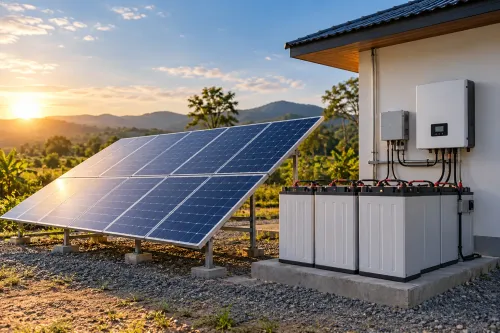
| Off-grid | Worst solar season and peak load | Battery autonomy, surge capacity and a cloudy-weather plan |
An ordinary grid-tied system shuts down during a utility failure, so panels alone cannot provide power. Treat on-grid system outage backup as a separate specification: “battery-ready” does not mean backup is installed.
For an off-grid property, calculate nighttime demand and startup surges for motors and compressors. Adding panels will not fix inadequate battery capacity; the inverter, charge controller and backup strategy must match those loads.
Which Panel Technology and Specifications Fit the Site?
Choose the panel that delivers the required lifetime energy within your usable roof area, not the one with the largest label. Rated wattage is measured at Standard Test Conditions: 1,000 W/m² irradiance, 25°C cell temperature and air mass 1.5. Real output falls with heat, weak sunlight, dust, wiring losses and inverter losses.
| Technology | What to compare | When it fits |
|---|---|---|
| Monocrystalline panels | Highest panel efficiency, compact dimensions and strong output per square metre; usually costs more | Choose them when roof space is limited or you want a smaller array |
| Polycrystalline panels | Lower panel efficiency but often a lower purchase cost; check whether extra area is available | Choose them when roof space is generous and budget matters |
| Thin-film panels | Lower efficiency, larger area requirement and sometimes better low-light or hot-condition performance; construction and mounting vary by product | Choose them for large roofs, lightweight structures or unusual surfaces after checking the installation method |
Compare each datasheet’s temperature coefficient, low-light performance, dimensions, weight, voltage and current. Two modules with identical wattage can occupy different areas, leaving different room for access paths and required setbacks.
Ask for modeled annual kWh, the first-year output, the guaranteed end-of-term power and the assumed annual degradation rate. A higher-efficiency panel does not automatically produce proportionally more energy, while a favourable warranty claim is weak if the quote omits its degradation assumptions.
Will the Panels and Inverter Work Reliably in Nagpur?
Nagpur solar panel performance falls as cell temperature rises: output drops according to the panel’s temperature coefficient above the rated 25°C cell temperature. Compare that figure, not just rated watts, and request an annual model using local heat, soiling and monsoon irradiance.
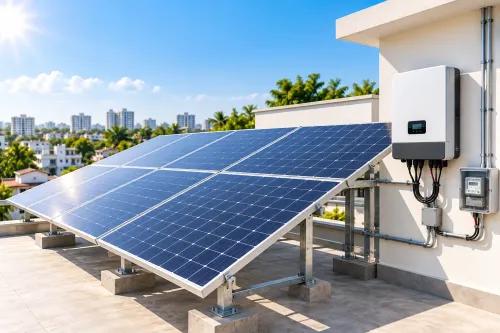
- Confirm the inverter’s MPPT voltage range suits the array’s maximum power voltage in hot weather; voltage falls as cells heat.
- Check that the string’s cold-weather open-circuit voltage stays below the inverter’s maximum DC input voltage.
- Check short-circuit current against each MPPT’s input-current limit, including the manufacturer’s required design margin.
- Choose an inverter with an IP65 or IP66 enclosure, thermal derating data, surge protection, earthing and adequate ventilation clearance.
Dust reduces light reaching the cells, so inspect and clean modules after dusty periods; do not scrub hot glass or use untreated hard water. Monsoon humidity and driven rain expose weak connectors and roof penetrations, so require sealed connectors, tidy cable loops and corrosion-resistant mounting hardware.
A grid-tied inverter shuts off during outages; select separately configured backup equipment if essential loads need power. Verify service access before signing.
What Does the Quoted System Capacity Actually Mean?
A quoted 5 kW system can mean 5 kW of DC panel capacity, 5 kW of AC inverter capacity, or both. Confirm each figure before comparing proposals.
| Figure | What it means | What to check |
|---|---|---|
| DC panel capacity | Combined laboratory rating of all modules | Panel wattage, roof layout and expected clipping |
| AC inverter capacity | Maximum power converted for your property | Inverter rating, surge capability and monitoring |
| Annual solar generation | Modeled electricity produced in kWh over a year | Assumptions for shading, heat, dust, losses and orientation |
| Export limit | Maximum electricity allowed into the utility grid | Utility approval, meter setting and sanctioned load |
The panel total is calculated under Standard Test Conditions: 1,000 W/m² sunlight and 25°C cell temperature. Actual output falls with heat, dust, weak sunlight, wiring losses and inverter losses, so compare the quoted annual solar generation with your 12-month consumption rather than multiplying panel watts by sunshine hours.
Ask whether a larger DC array is connected to a smaller inverter; that design can increase production during weak sunlight but clips output at the inverter’s AC limit. Then check whether net metering permits the surplus to reach the grid.
A utility’s export limits or your sanctioned load can restrict system size, regardless of roof space. Get those limits in writing before signing.
What Should the Quote, Warranty and Installer Promise Include?
A low price is not a complete proposal. Compare the equipment, approvals, exclusions and named person responsible after commissioning, not just the total amount.
| Item | What the proposal must state | Why it matters |
|---|---|---|
| System price | Panel and inverter models, DC and AC capacity, mounting, wiring, taxes and labour | Prevents missing-cost surprises |
| Panel coverage | Solar panel product warranty, performance warranty and degradation rate, plus guaranteed end-of-term output | Two panels with the same wattage can produce different lifetime energy |
| Other equipment | Inverter and mounting warranty, optimizer or battery coverage, and who pays shipping, labour and roof removal | A panel warranty may not cover the failed component or access work |
| Approvals | Permit responsibility, utility interconnection and electrical inspection, meter changes and export limits | An unapproved system can delay connection or prevent grid export |
| Service | Commissioning documents, monitoring access, response times, claim procedure and cover if the installer closes | You need a route to repair, not only a warranty leaflet |
Ask who repairs roof damage and pays to remove and reinstall panels when the roof needs work. Obtain the utility’s written requirements; do not assume a national net-metering rule applies locally. A proposal from Orange Sun Power Solutions should be judged by these documented commitments, not its brand list.
Get every promise attached to the signed contract.
Frequently asked questions
How do I know whether my roof suits a solar array?
Measure usable, unshaded roof area after excluding ridges, vents, skylights, access paths and required setbacks. Check structural condition and the route to the electrical connection.
How much electricity should my solar system supply?
Review 12 months of electricity bills, identify daytime and night-time consumption, and size the system against your target reduction rather than roof area alone.
Which solar panel specifications should I compare?
Compare panel dimensions, rated wattage, efficiency, temperature coefficient, degradation warranty and product warranty. Confirm that the inverter accepts the panels’ voltage and current range.
What should a solar quote and warranty include?
Ask for system capacity, panel and inverter model numbers, mounting and protection equipment, installation scope, generation assumptions, warranty periods, exclusions, payment stages and after-sales response terms.