A rooftop-solar subsidy is not usually an instant discount at the time you sign a quotation, and a low EMI can cost more than the electricity savings it supports. You will be able to verify eligibility, follow the subsidy process, compare loan structures and calculate the real cost before approving installation.
Key takeaways
- Claim ₹30,000 per kW for the first 2 kW and ₹18,000 for the third.
- Use the PM Surya Ghar portal, DISCOM approval and inspection to release subsidy.
- Compare total interest, processing fees and prepayment rules—not just the advertised EMI.
- Check panel, inverter, warranty, net-metering and subsidy details in the quotation.
Which rooftop-solar subsidy applies to your home?
For a homeowner in Maharashtra, the main claim is under PM Surya Ghar: Muft Bijli Yojana. It provides central financial assistance for eligible residential grid-connected rooftop solar systems: ₹30,000 per kW for the first 2 kW and ₹18,000 for the third kW.
The maximum central subsidy is ₹78,000 for a system of 3 kW or more.
Your system must meet the scheme’s current conditions and the relevant electricity distribution company’s requirements. An off-grid system with batteries is not automatically eligible. A battery is also not compulsory for a grid-connected system; it mainly provides outage backup or stores energy for later use.
Treat these items separately from the central subsidy:
| Benefit | What it covers | How to treat it |
|---|---|---|
| Maharashtra solar subsidy | Any state incentive available under current Maharashtra rules | Verify separately; do not add it to the central amount without confirmation |
| Utility rebate | DISCOM support, metering concession or export-related benefit | Check the applicable net-metering order and customer category |
| Tax treatment | Any deduction or tax consequence | Confirm with a tax professional; it is not a subsidy |
| Lender discount | Interest reduction, fee waiver or cashback | Compare with the loan’s total repayment |
| Solar water-heater support | Hot-water equipment and its energy savings | Assess separately from photovoltaic electricity |
A solar water heater does not produce electricity for your other household loads, so do not include its savings in a rooftop-PV subsidy calculation.
How the PM Surya Ghar application moves from portal to subsidy
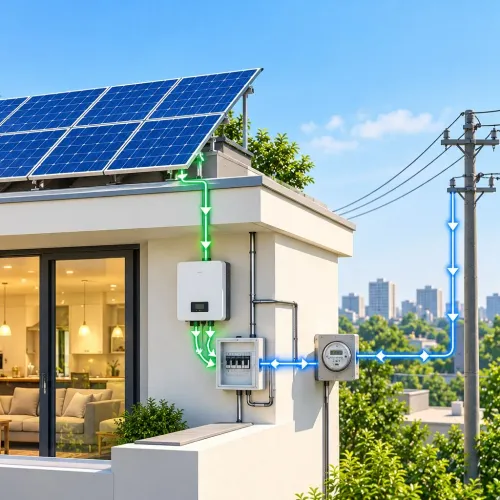
The subsidy is claimed after the system is installed, inspected and connected—not as an automatic discount at booking. Start with national portal registration using your electricity consumer number, mobile number and distribution company details.
1. Submit the application and upload identity proof, address proof and a recent electricity bill. Confirm that the connection is residential and grid-connected.
2. Choose a registered vendor listed on the portal. Obtain a written quotation showing capacity, equipment, installation charges, taxes and the proposed payment schedule.
3. Wait for DISCOM feasibility approval before installation. Do not allow work to begin on an application that remains pending or rejected.
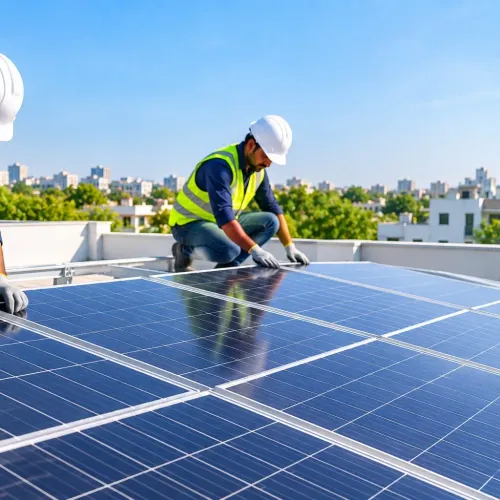
4. Sign the vendor agreement, pay the amount required under your contract, and complete installation. The vendor uploads the invoice, system details, serial numbers, photographs and completion information.
5. Submit the net-metering application. The DISCOM inspects the installation, verifies the equipment and wiring, and issues net metering approval before installing or replacing the meter.
6. After commissioning, confirm that the portal claim contains the inspection record, meter details, bank account information and cancelled cheque or bank proof. A lender may also request the sanction letter, property or roof-use permission and the final invoice.
The subsidy authority releases the approved amount through direct bank transfer after document and installation validation. Ask who receives any lender-adjusted subsidy: if the lender applies it to the loan principal, your outstanding balance falls; otherwise, the money reaches your registered bank account after processing. Keep the portal acknowledgement, invoice, meter document and payment receipts.
Which solar loan structure gives you the lowest real cost?
The lowest real cost is usually the option with the lowest APR and total repayment, not the smallest EMI. Compare processing and documentation fees, insurance, late charges, prepayment rules, tenure and whether the subsidy reduces the principal.
| Option | Interest and security | Fees and repayment rules |
|---|---|---|
| Dedicated solar home loan or green loan | Often priced for solar and available as secured or unsecured credit; confirm whether your house, system or no asset secures it. | Check APR, technical inspection fees, mandatory insurance, fixed or floating rate, prepayment charge and whether subsidy is credited against principal. |
| Home-loan top-up | Usually uses your existing home mortgage security and may offer a lower rate than unsecured borrowing. | It can add legal, valuation and processing fees. The longer tenure lowers EMI but increases interest; mortgage-linked repayment and foreclosure terms apply. |
| Personal loan for solar | Unsecured, so the rate is usually higher than a secured top-up. Approval depends on income and credit history. | Expect processing fees and stricter late-payment consequences. Repayment starts under the personal-loan schedule, regardless of when the system produces savings. |
| Vendor finance | The installer arranges or embeds lender credit; security, rate and ownership terms vary by contract. | Check bundled prices, down payment, cancellation, installation-linked disbursement, subsidy handling and repossession or warranty consequences after missed EMIs. |
Ask each lender for the sanction letter and amortisation schedule. Compare total repayment after every fee, then subtract only the subsidy amount that the lender confirms will reduce your outstanding principal. A cheap EMI can still produce the highest lifetime cost.
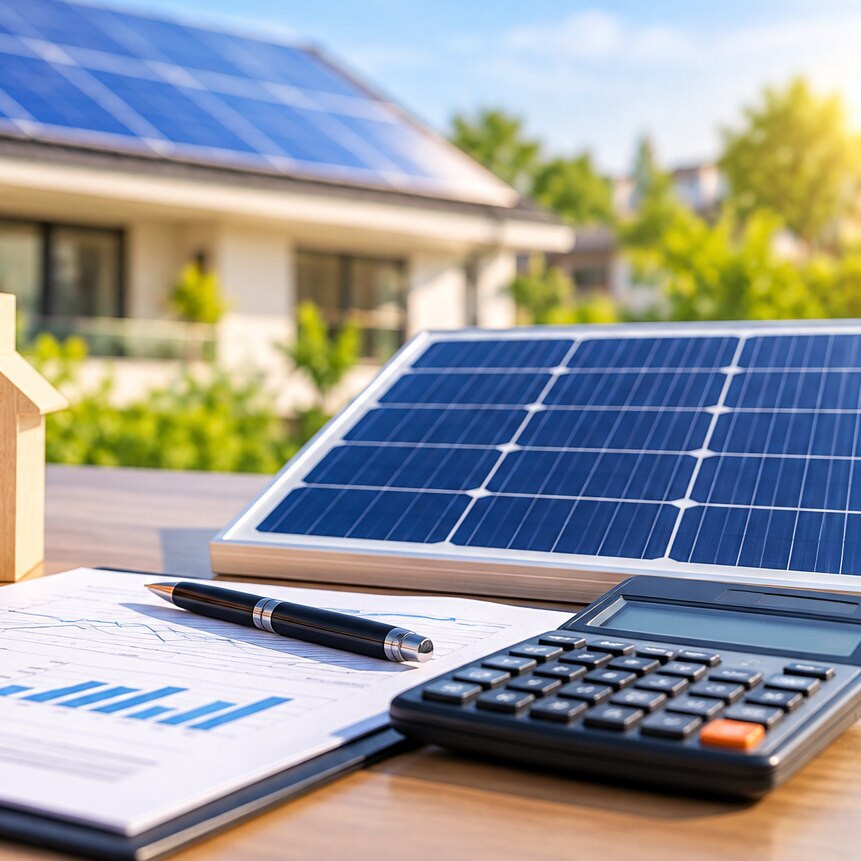
How to calculate EMI, subsidy-adjusted cost and break-even
1. Test it by calculating the solar loan EMI, the subsidy-adjusted cost and the payback period, then compare both monthly cash flow and total lifetime cost. Record the system price, installation charges, subsidy amount, down payment, loan fees and expected annual bill reduction.
2. Calculate the financed principal as the eligible system cost plus financed fees minus the down payment and any subsidy credited immediately. Use: EMI = P × r × (1 + r)^n ÷ ((1 + r)^n − 1).
Here, P is the principal, r is the monthly interest rate and n is the number of monthly instalments. Request the lender’s amortisation schedule.
3. Add the down payment, every EMI, processing and documentation fees, insurance, and late or prepayment charges to find the loan’s total outflow. Subtract a subsidy only when it is actually received or credited to the principal. This gives a realistic subsidy-adjusted cost; a longer tenure lowers EMI but raises total interest.
4. Estimate annual savings from self-consumed solar electricity and exported units separately. Apply your distribution company’s net-metering rules, export credit and settlement period instead of valuing every unit at the highest retail tariff.
Calculate simple break-even as subsidy-adjusted cost divided by annual net savings, then check whether annual savings cover the EMI and whether lifetime savings exceed total repayment, maintenance and likely inverter replacement costs. If the loan repayment exceeds reliable savings for years, reduce the system size, increase the down payment or reject the purchase.
What to verify in the quotation before choosing an installer
Do not sign or submit a loan application until the quotation states the system design, expected output, roof work, warranties and every payment milestone. A panel count based only on your monthly bill can ignore shading, seasonal production, daytime usage and tariff structure.
| Check | Confirm in writing | Why it matters |
|---|---|---|
| Design | Roof orientation, usable area, shade assessment, panel count, DC capacity, inverter AC capacity and single-line diagram | Confirms the proposed system fits your roof and electrical connection |
| Output | Annual energy production, modelling assumptions, degradation rate, losses and expected first-year AC generation | Nameplate kW is not delivered electricity |
| Roof | Structural inspection, mounting method, wind loading, waterproofing, cable routes and removal costs | A roof nearing replacement can make installation expensive twice |
| Warranty | Solar panel warranty, inverter and battery terms, workmanship period, exclusions, labour, shipping and claim procedure | A panel warranty does not cover leaking roofs or poor installation |
| Payment | Tax-inclusive price, subsidy treatment, deposit, balance milestones, loan fees, cancellation terms and total loan repayment | A low EMI can hide high interest or an unpaid balance |
Ask Orange Sun Power Solutions, or any competing installer, to attach the shade report and production estimate rather than promising daily generation. Confirm the applicable net-metering rules: system-size limits, export settlement, billing cycle and compensation rate. Compare quotations on annual energy production, equipment scope and total repayment, not just price or panel wattage.
Related product
 | Residential Solar Rooftop We also have the largest private solar bungalow installation and are the most advanced in constructing and maintaining Bungalow aesthetics. View product → |
Frequently asked questions
Which rooftop-solar subsidy applies to a home in Maharashtra?
Eligible residential grid-connected systems use PM Surya Ghar: Muft Bijli Yojana. Central assistance is ₹30,000 per kW for the first 2 kW and ₹18,000 for the third kW.
How does the PM Surya Ghar subsidy reach the homeowner?
Apply through the PM Surya Ghar portal, select an approved vendor, complete installation, arrange DISCOM inspection and net-metering steps, then submit the required completion details for subsidy release.
Which solar loan has the lowest real cost?
Compare the total repayment after interest, processing fees, insurance, foreclosure charges and other costs. A lower EMI does not guarantee a lower overall cost.
How do you calculate the subsidy-adjusted solar cost and break-even?
Subtract the eligible subsidy from the installed system price, add loan interest and fees, then divide the net cost by expected annual electricity savings to estimate simple payback.
What should you verify in a solar quotation before choosing an installer?
Check panel and inverter models, system capacity, warranties, mounting structure, earthing, protection devices, net-metering work, taxes, installation scope, subsidy assumptions and payment milestones.