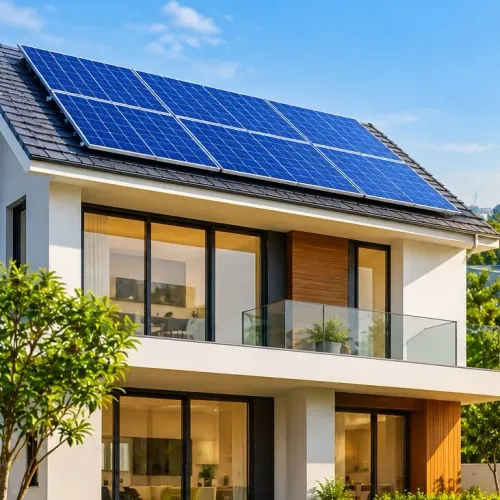
Solar panels do not replace the grid; they work alongside it, supplying available daytime power, exporting surplus electricity and drawing power when production falls short. By tracing that flow and checking your bills, roof, tariff and backup needs, you can decide whether an on-grid system fits your property and compare quotations on useful technical and financial terms.
Key takeaways
- Solar power serves your appliances first; excess electricity flows to the grid.
- An on-grid inverter shuts down during outages unless backup equipment is installed.
- Size the system from annual electricity use, roof space and daytime demand.
- Compare inverter capacity, panel output, warranties and net-metering rules before buying.
How electricity moves through an on-grid system
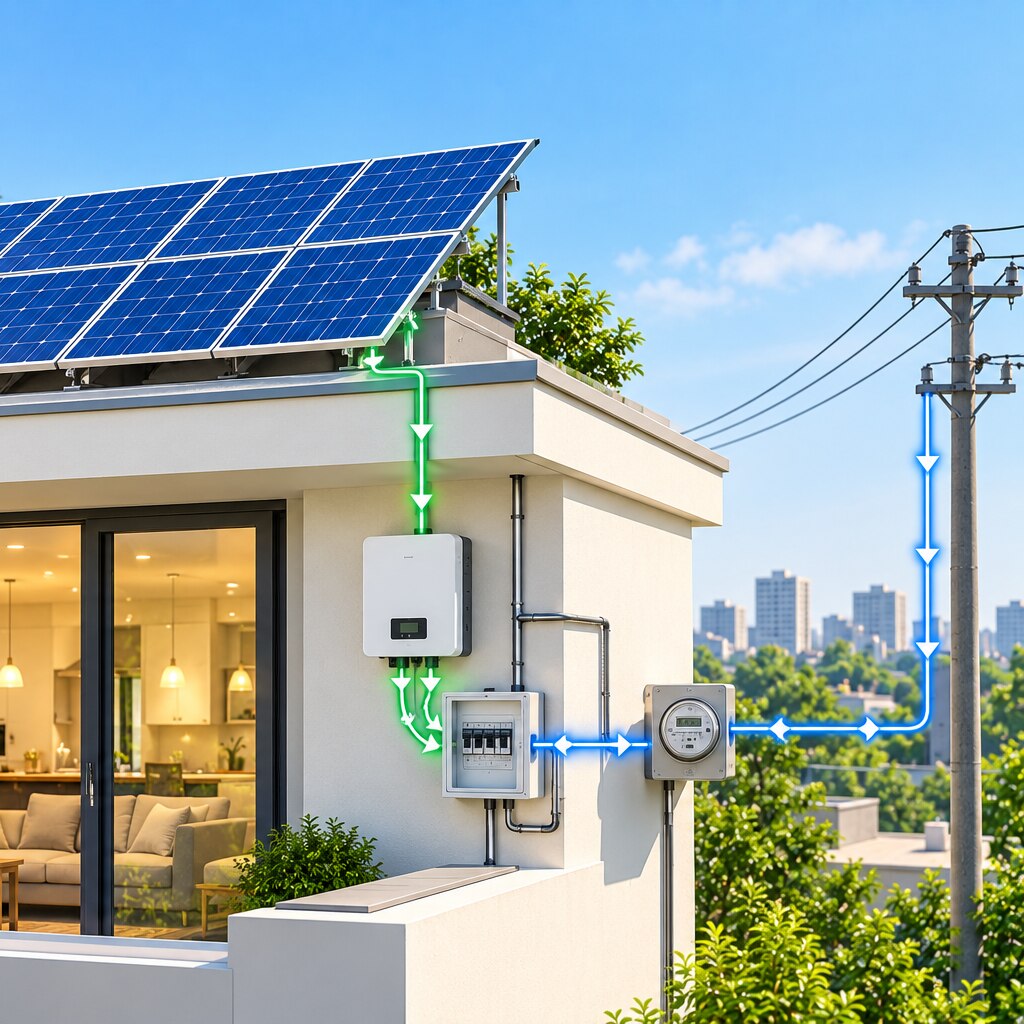
Sunlight produces direct-current electricity in the PV modules. That power travels through DC cabling to a grid-interactive inverter, which converts it into alternating current and synchronises its voltage and frequency with the utility supply. The AC then enters the AC distribution board, where it serves household or facility appliances.
A bidirectional meter measures electricity moving in both directions between the property and the utility grid.
- When solar output is lower than demand, the loads use available solar power first and draw the shortfall through the meter from the grid.
- When solar output exceeds demand, the loads consume what they need and the surplus flows through the meter to the grid, if the approved interconnection and tariff permit export.
- At night or during low production, the property imports electricity from the grid. The meter records those units separately from exported units for the utility’s billing and credit rules.
Solar output follows sunlight, cloud cover and module temperature, not your appliance demand. An on-grid solar system normally operates without batteries, so it reduces purchased electricity rather than guaranteeing power during every hour.
A standard grid-tied inverter must shut down when the utility supply fails. This anti-islanding protection prevents the system from energising lines while utility workers repair them.
Backup operation requires a battery, an islanding or transfer device, and an inverter with a dedicated backup output; adding more PV modules alone will not keep appliances running in a blackout.
What happens when solar output or the grid changes
At any moment, solar output follows sunlight and module temperature—not your appliance demand. The inverter supplies on-site loads with available AC power, while the difference determines whether power moves through the meter.
- If demand exceeds production, the inverter uses all available solar electricity first. The shortfall comes from the utility grid, creating grid import and export in the opposite direction from surplus conditions. This happens on cloudy afternoons, after sunset and whenever several appliances run together.
- If production exceeds demand, the extra becomes surplus solar electricity. It flows through the bidirectional meter to the grid when the interconnection and tariff permit export. The utility then records that export under the applicable billing arrangement; it does not mean every exported unit earns the same value as an imported unit.
- If the utility supply fails, a standard grid-tied inverter shuts down even when sunlight is strong. This anti-islanding protection prevents the system from energising a line that workers may believe is dead.
More panels do not create blackout backup. To operate selected circuits during an outage, the installation needs a battery, an inverter with a backup output and equipment that isolates those circuits from the utility line. Without that dedicated backup design, the home remains without solar power until grid service returns.
Net metering, bills and the equipment behind the connection
A bidirectional meter records electricity imported from the grid and surplus electricity exported to it. Under net metering in Maharashtra, the distribution utility compares these readings during each settlement period and applies eligible export units as credits against imported units.
Confirm the current Maharashtra rules, export limits and settlement schedule with your distribution utility before relying on projected savings.
| Condition | Meter record | Bill effect |
|---|---|---|
| Solar output below demand | Import reading rises | You pay for the shortfall |
| Solar output above demand | Export reading rises | Eligible export becomes a credit |
| No solar, grid available | Import reading rises | You buy electricity from the utility |
| Grid outage | Inverter stops energising | No normal grid-tied supply |
Exported electricity does not always receive the same rate you pay for imported electricity. Tariffs can include fixed charges, taxes, minimum charges, time-based rates or separate export compensation, so a system can reduce consumption charges without eliminating the bill.
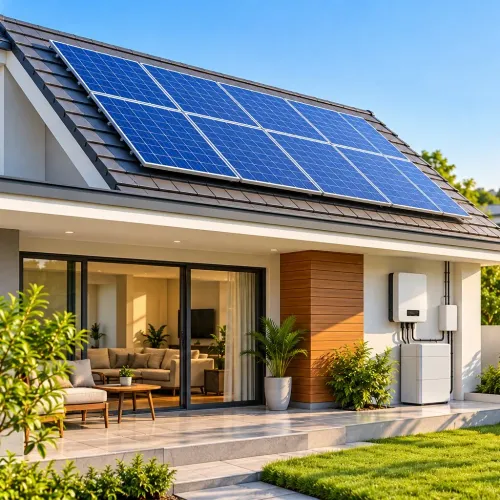
The connection also needs a grid-interactive inverter, DC isolator and AC protection, earthing, mounting equipment and an approved bidirectional meter. The inverter must detect abnormal grid voltage or frequency and disconnect; a standard on-grid inverter therefore cannot provide backup during a blackout.
Before installation, obtain the utility’s interconnection approval. Ask what documents it requires, including the application, inverter certification, single-line diagram, electrical inspection, meter replacement and permission to operate. Do not switch on an installed system until the utility grants that permission.
How to size an on-grid system for a real property
Size the array by matching annual electricity consumption with realistic solar production, then reduce it for roof and export limits. The largest array that fits is not automatically the best investment.
1. Collect 12 months of electricity bills and record each month’s kWh, not only the rupee total. Separate fixed charges, taxes, demand charges and time-of-use rates; solar generation will not remove these costs.
2. Measure the daytime load between sunrise and sunset. Air conditioners, pumps, refrigerators and office equipment running during solar hours use generation directly. A small system serving daytime demand can deliver more value than a larger system whose surplus receives low export credit.
3. Ask for a solar assessment based on Nagpur’s irradiance, module temperature, orientation, tilt, inverter efficiency and wiring losses. Estimate annual kWh per installed kW with a site-specific simulation, then divide your target annual generation by that figure. Do not size from panel wattage alone.
4. Map the shadow-free roof area in Nagpur, including parapets, water tanks, access paths and fire-maintenance clearances. Exclude areas shaded by trees or neighbouring buildings; partial shade can reduce a series string’s output disproportionately.
5. Check the Maharashtra distribution utility’s current export cap, interconnection rules and compensation rate. If exports earn less than imported electricity, cap the system near useful on-site consumption rather than filling every available roof section.
6. Compare the estimate with the sanctioned load and inverter limit. Request the assumptions, monthly production forecast and shading analysis in writing before approving the design.
Which system and specifications make financial sense
Choose the architecture that matches your roof and purpose, not the highest panel count. A string inverter is usually the lower-cost choice for an unshaded roof with similar panel orientations; a microinverter suits multiple roof faces or partial shading; a hybrid inverter earns its extra cost only when battery storage and backup loads matter.
| Option | Strength | Financial drawback | Best fit |
|---|---|---|---|
| String inverter | Fewer electronic units and simpler servicing | One shaded module can restrict its series string | Unshaded, single-orientation roofs |
| Microinverter | Module-level monitoring and better mismatch control | Higher equipment and replacement cost | Roofs with shade, dormers or several orientations |
| Hybrid inverter | Battery charging and backup-load control | Battery, changeover equipment and additional protection raise the budget | Properties that value outage power |
Compare panel wattage with temperature coefficient, product warranty, degradation terms and the roof’s usable area. For the inverter, check efficiency, number of MPPT inputs, its MPPT range and maximum DC voltage against the planned string voltage at the coldest expected temperature. Do not accept a panel total that exceeds the inverter’s permitted DC input.
Demand an itemised quotation covering mounting, DC and AC protection, cables, earthing, monitoring, structural work, utility application, inspection, meter change and permission to operate. Compare the same system size and forecast assumptions: PVWatts uses a default 14% system-loss assumption, so ask for tilt, azimuth, shading and loss inputs.
Whether you choose Orange Sun Power Solutions or another installer, require the exclusions and service response time in writing.
Related products
 | System Intergration - On Grid We develop and commission on-grid MW scale solar power projects on turnkey basis. View product → |
 | Inverter Inverter A Solar Inverter is a device that converts the direct current (DC) from the solar panels into alternating current (AC). |
Frequently asked questions
How does electricity move through an on-grid solar system?
PV modules produce direct current, DC cabling carries it to a grid-interactive inverter, and the inverter converts it to synchronised alternating current. The AC distribution board sends power to appliances and the grid connection.
What happens when solar output or the grid changes?
Clouds reduce PV output, so the property draws the shortfall from the grid. When solar production exceeds on-site demand, excess electricity flows to the grid. A standard on-grid inverter shuts down during a grid outage to protect utility workers.
How do net metering and solar bills work?
A bidirectional meter records electricity imported from and exported to the grid. Your bill applies the utility's approved rules to those readings, including any fixed charges, credit limits or settlement period.
How do you size an on-grid solar system for a property?
Review at least 12 months of electricity bills, calculate annual consumption, identify daytime loads, check usable roof area and account for shading and local solar conditions. Then match expected generation with the utility's permitted system size.
Which on-grid solar specifications matter financially?
Compare annual energy yield, inverter efficiency and warranty terms rather than panel wattage alone. Check the inverter's rated AC output, protection features, monitoring, replacement cost and compatibility with your utility connection.
Related products
 | Commercial Solar Rooftop A commercial solar system involves the installation of solar panels on a commercial or business property to generate electricity. View product → |
 | Industrial Solar Rooftop An industrial solar rooftop project involves the installation of solar panels on the rooftops of industrial buildings or facilities to generate... View product → |
 | Solar Panels We have wide range of solar panel. Solar Tie Grid System, Solar Street Light System, Solar Off Grid System, Solar Water Heater, Solar Pump. View product → |
 | Residential Solar Rooftop We also have the largest private solar bungalow installation and are the most advanced in constructing and maintaining Bungalow aesthetics. View product → |