
Start with electricity bills, interval load data and the roof itself—not a panel count copied from another building. By the end, you will have a practical way to estimate system size, test outage requirements, compare alternatives and prepare the approvals and commissioning checks needed before the system operates.
Key takeaways
- Collect 12 months of bills, including demand charges and export credits.
- Inspect roof condition, shading, access, structure and available electrical capacity.
- Size the system from interval load data, usable roof area and export limits.
- Match grid-tied, hybrid or off-grid architecture to outage and backup requirements.
Build the business case from actual electricity use
Collect at least 12 months of electricity bills before comparing commercial solar planning proposals. The bills show monthly kWh consumption, but the business case also depends on tariff slabs, demand charges, time-of-use rates, export credits, fixed charges and the sanctioned load.
A property with high annual use but little daytime load may save less than one with lower consumption and steady daytime operation.
1. Request 15-minute or 30-minute interval data from the utility for a full year. Mark opening hours, seasonal closures, equipment start-up peaks and the loads that operate during sunlight.
2. List each major load in kilowatts: air-conditioning, refrigeration, lifts, computers, lighting, pumps and machinery. Record which loads must run during an outage, because backup capacity is priced against critical-load kW and required hours, not total monthly consumption.
3. Ask the designer to model the proposed array in PVWatts or equivalent software using the site location, roof tilt, azimuth, shading, inverter efficiency and system losses. Compare monthly generation with monthly demand; annual kWh alone can hide a costly seasonal mismatch.
4. If hot water is a major expense, record daily volume, temperature, storage capacity and backup-heater use separately. Solar water heating is not the same as adding photovoltaic panels.
Compare battery costs against a defined purpose: backup, peak-demand reduction, time-of-use shifting or export limitation. Use usable kWh, charge and discharge power, efficiency and degradation in the calculation, not nameplate capacity alone.
Survey the roof before counting panels
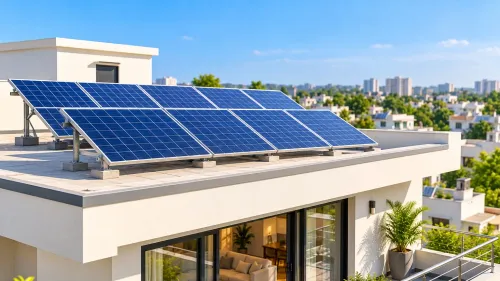
A roof can carry a solar array safely and practically only after you check both its usable roof area and roof structural strength. The roof outline is not the panel count.
1. Get roof drawings, maintenance records and warranty terms. Inspect the surface for ponding, cracks, corrosion, loose sheets and damaged membrane.
2. Mark every obstruction on a roof plan: parapets, HVAC units, vents, skylights, drains, access routes and roof edges. Apply required fire clearances and maintenance setbacks, then calculate the remaining usable roof area.
3. Ask a structural engineer to check module and racking weight, ballast, attachment points, wind uplift and local wind or snow loads. An apparently sound roof can still fail around fixings or deflect enough to damage panels.
4. Check waterproofing and roof age before approving penetrations. If the roof is near the end of its service life, repair or replace it first; removing and reinstalling an array later adds labour, downtime and the risk of new leaks.
5. Map the shadow-free space across the day and year, including shadows from tanks, trees, neighbouring buildings and future construction. A shaded row reduces output and can complicate string design.
Use the measured tilt, azimuth, location and obstructions in PVWatts or equivalent modelling. Compare monthly production with daytime demand before finalising the panel layout.
Convert load data and roof space into a system size
Use the roof and interval load data to set four different quantities; do not treat kW and kWh as interchangeable.
- kW panel capacity = usable, shadow-free roof area ÷ area of one panel × each panel’s kW rating. Leave space for walkways, fire access, maintenance and row spacing, then apply shading and temperature losses.
- kW inverter capacity = the highest simultaneous operating load, including motor-starting surges from pumps, compressors or lifts. Compare this figure with the sanctioned load and select an inverter with adequate continuous and surge ratings.
- kWh generation = modeled solar output, not panel capacity multiplied by daylight hours. Enter the roof tilt, azimuth, shading, weather location, inverter efficiency and system losses into PVWatts or equivalent software; check both annual and monthly results.
- kWh battery storage = critical-load kW × required backup hours ÷ usable battery fraction ÷ battery efficiency. Specify usable kWh, charge and discharge kW, temperature limits and degradation, rather than relying on nameplate capacity.
A 100 kW panel array and a 100 kW inverter are not automatically the right match. The inverter may be smaller than the array to improve performance during weak sunlight, but its output must support the building’s coincident load and export limit.
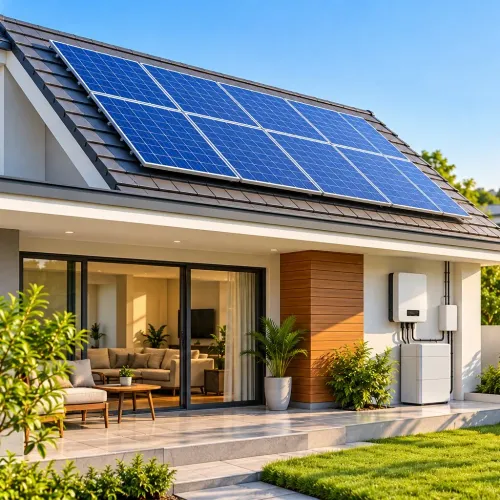
Size a battery for a defined purpose: outage backup, peak-demand reduction, time-of-use shifting or export control. A grid-tied inverter shuts down during an outage, so backup also requires a battery system, backed-up load panel and approved islanding equipment.
Choose the right power architecture for daily use and outages
Choose architecture by the cost of an outage, not by panel capacity: use on-grid solar for bill reduction, hybrid solar for selected backup power, and off-grid solar only where the grid is unavailable or unreliable.
| Option | Daily operation | Outage support | Choose it when |
|---|---|---|---|
| On-grid solar | Solar serves daytime loads; the grid supplies shortfalls and night use | No power from standard grid-tied inverters; they shut down to prevent unintentional islanding | The property has dependable utility service and outages do not threaten trading, refrigeration or data |
| Hybrid solar | Solar, grid and batteries share loads; batteries can shift energy or reduce demand peaks | A backed-up panel supplies critical loads such as networking, security, lights, billing equipment and refrigeration | You need resilience without powering the entire building |
| Off-grid solar | Solar and batteries provide all electricity; a generator may cover long cloudy periods | The system carries the planned loads through its autonomy period | No practical grid exists, or outage frequency makes grid dependence unacceptable |
Do not connect every appliance to backup power. Exclude electric water heaters, air-conditioning compressors, large pumps and workshop motors unless the battery inverter handles their running and starting kW. Keep essential lighting, routers, alarms, point-of-sale devices, medical equipment and cold storage on the critical-loads panel.
Size batteries from critical-load kW, required hours, usable kWh, inverter surge rating, temperature and degradation—not from panel output alone. For off-grid solar, use the worst operating period, an explicit energy budget and load-shedding sequence.
Orange Sun Power Solutions can test these assumptions against interval bills, motor starts and the proposed backup panel before equipment is selected.
Related products
 | Commercial Solar Rooftop A commercial solar system involves the installation of solar panels on a commercial or business property to generate electricity. View product → |
 | System Intergration - On Grid We develop and commission on-grid MW scale solar power projects on turnkey basis. View product → |
Plan approvals, installation, commissioning and performance checks
Reliable operation starts only after approvals, controlled installation, witnessed energization and measured output—not when panels are fixed to the roof.
Confirm these items before construction:
- Obtain building and electrical permits, structural approvals and fire-access clearances required by the local authority.
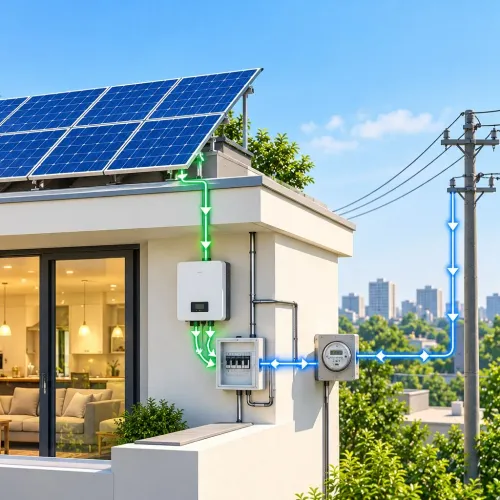
- Submit the utility interconnection application with the single-line diagram, inverter and protection details, equipment certifications, export limit and proposed meter arrangement.
- Resolve utility conditions, including a technical study, protection settings, witness testing or anti-islanding requirements. An installed array cannot automatically operate in parallel with the grid.
- Lock the construction drawings, shutdown plan, cable routes, earthing points, roof penetrations and delivery schedule.
During installation, inspect mounting fasteners, waterproofing, module strings, DC isolators, AC protection, labels and cable support before closing ceilings or ducts. Keep photographs and test records for handover.
Use a commissioning checklist covering insulation resistance, polarity, continuity, earthing, torque, inverter configuration, meter operation, monitoring access and emergency shutdown. Test the backed-up load panel separately; a standard grid-tied inverter will shut down during an outage unless an approved battery or microgrid system provides islanding control.
Compare actual generation with a PVWatts or equivalent model using the roof’s azimuth, tilt, shading, location, inverter efficiency and losses. Check monthly output, not just annual kWh, and investigate persistent underperformance.
For solar water heating, commission the collectors, storage tank, pumps, freeze and overheating protection, backup heater and hot-water controls as one thermal system. Verify delivered water temperature and flow under the building’s real draw pattern.
Frequently asked questions
How many electricity bills should you collect before planning commercial solar?
Collect at least 12 months of bills to compare kWh use, tariff slabs, demand charges, fixed charges, export credits and sanctioned load.
What should a commercial solar roof survey check?
Check roof condition, structural capacity, shading, drainage, access, fire-safety routes, equipment space and the route to the electrical connection.
How is a commercial solar system size calculated?
Compare electricity demand with usable roof area, solar generation potential, inverter limits, sanctioned load and any restriction on exporting power.
Which solar power architecture suits a business?
Choose grid-tied systems for bill reduction, hybrid systems when selected loads need backup, and off-grid systems when reliable grid supply is unavailable.
What happens after a commercial solar installation is approved?
Plan utility approvals, equipment delivery, mounting and wiring, commissioning tests, meter work, monitoring setup and performance checks against expected generation.
Related product
 | System Intergration - Off Grid System Intergration - Off Grid We offer turnkey solutions to our customers. This entails feasibility studies, a design of demand specific systems, installation and maintenance of... View product → |